
Making the Invisible Visible: Real-Time Monitoring of Perovskite VCD Drying
Dual-modal in-situ thickness (5–1200 nm) and PL monitoring of perovskite VCD drying for process control.
The vacuum drying process plays a critical role in determining the quality and performance of perovskite thin films. Within just a few seconds, rapid solvent evaporation, film thickness reduction, and crystallization can significantly influence the final film morphology, defect density, and ultimately, solar cell efficiency.
Despite its importance, monitoring these rapid transformations in real time has traditionally been a major challenge for perovskite manufacturers.
TDM Technology is addressing this challenge through advanced in-situ optical monitoring solutions that provide valuable insights into the dynamic behavior of perovskite thin films during Vacuum Chamber Drying (VCD).
Recently, we successfully conducted a dual-modal in-situ monitoring test on a customer’s VCD production equipment, simultaneously tracking film thickness evolution and photoluminescence changes throughout the drying process.
Our monitoring approach provides valuable capabilities for perovskite manufacturing:
- Real-Time Thickness Monitoring: Capturing rapid changes in film thickness during solvent evaporation and crystallization.
- Photoluminescence Monitoring: Observing the evolution of optical emission characteristics throughout the drying process.
- Manufacturing Quality Control: Supporting improved process consistency through real-time monitoring and data-driven analysis.
By transforming previously invisible process changes into measurable data, we aim to help perovskite manufacturers gain better process understanding, improve consistency, and support more data-driven manufacturing.
From process observation to process understanding — advancing precision metrology for next-generation photovoltaics.
What we measured
On a customer VCD process control module line, TDM ran dual-modal in-situ metrology: film thickness evolution and photoluminescence (PL) through the drying window.
- Thickness range: 5–1200 nm
- Repeatability: thickness ±0.5%; PL ±1%
- Sampling: <1 s per point
- Sample size: 10×10–220×220 mm
- Mounting: flange-port installation (PL head ≈40×40×199 mm / 0.5 kg; thickness head ≈180×180×50 mm / 1.5 kg)
How it mounts
The VCD process control module is designed for chamber / flange integration so thickness and PL heads can watch the same drying step without interrupting the process. See also the in-situ series and the longer In-situ thin film monitoring guide.
What the data shows
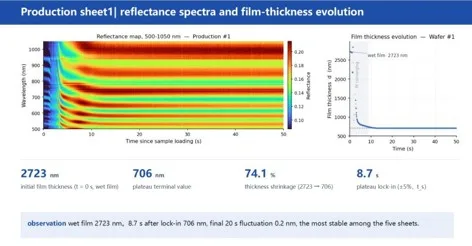
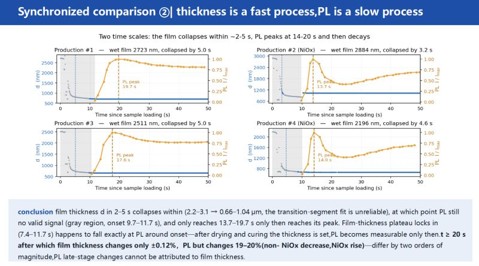
Thickness and PL traces make previously invisible solvent-loss and crystallization dynamics measurable — supporting tighter process windows and more consistent films.
Want the same trace on your chamber? Send your VCD recipe and drying window — we'll review your viewport and flange budget and tell you what in-situ thickness plus PL would show, including where it won't help. Request an in-situ feasibility review